I spent a few years working at a dive shop, and cylinders were a big part of that — filling them, inspecting them, watching customers handle them well or handle them badly. A tank is the one piece of gear on a dive that's actually a pressure vessel, and most divers never get taught the basics beyond "don't let it fall over." Here's what actually matters.
Types of Cylinders
Aluminum — the most common recreational tank, usually in 80 cubic foot (AL80) size. Slightly positive buoyant when empty, which is part of why divers add weight to compensate as the dive goes on. Cheaper to manufacture, more resistant to certain types of corrosion than steel, but the alloy is more prone to a specific issue called sustained load cracking around the neck threads on older tanks — one more reason VIPs matter.
Steel — less common in recreational rental fleets but popular with technical and serious divers. Smaller and more negatively buoyant for the same capacity, which means less lead on your belt. More durable, takes a higher working pressure in many cases, but rusts internally if water gets in and isn't dried out or treated.
Valve types — yoke vs. DIN. Yoke (A-clamp) is the standard recreational connection in the US, where the regulator clamps over the valve. DIN threads the regulator directly into the valve, which is more secure at higher pressures and standard in much of Europe and in technical diving. Some valves are convertible between the two.
Sizes — common recreational sizes run from small 13s and 19s (often used as pony bottles or for kids) up through 80s, with 100s and bigger used for deeper or longer dives. Bigger number generally means more air, more weight, and more buoyancy characteristics to account for.
Anatomy of a Cylinder Valve
The valve is the one part of the tank doing active work on every dive — sealing thousands of PSI, opening and closing on command, and acting as the single point where your regulator connects to your air supply. Worth knowing what's actually inside it.
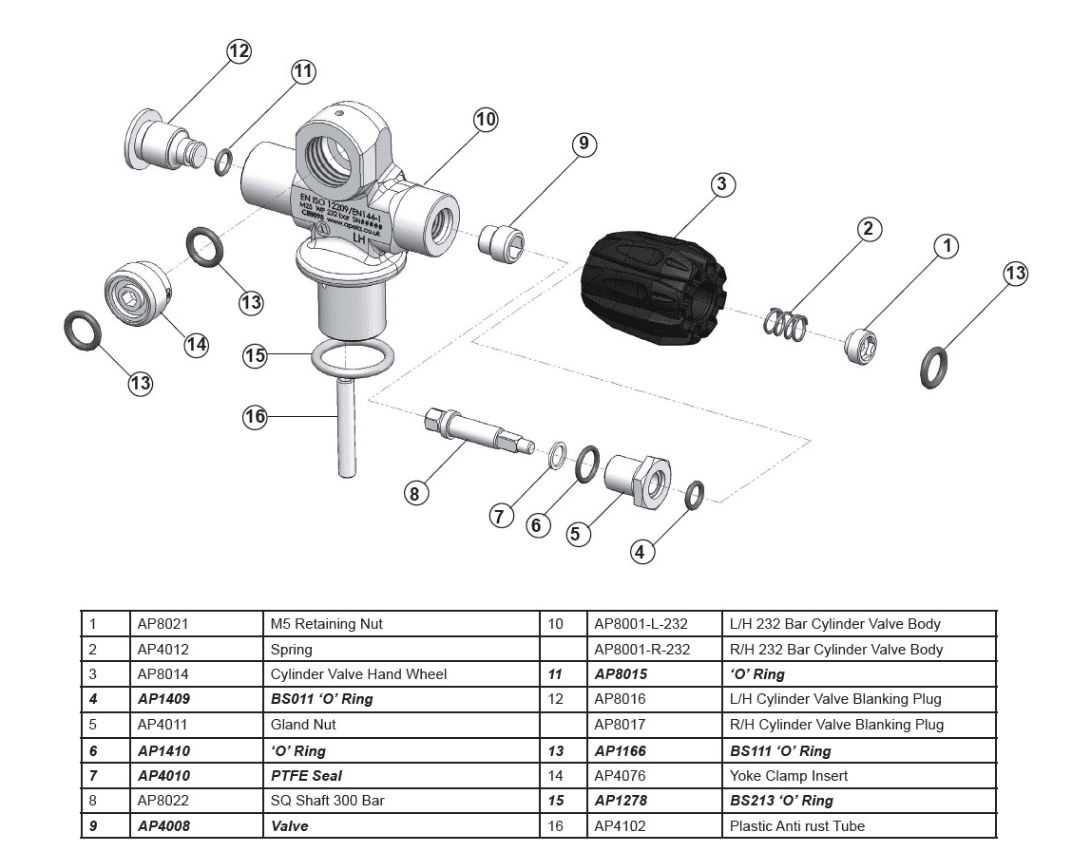
Breaking down the exploded view above:
- • Hand wheel — what you actually turn. It drives a shaft down onto the valve seat to open or close the tank.
- • O-rings — there are more of these in a valve than most divers realize, and they're the actual seal at every joint: the yoke face, the DIN insert, the valve body, the blanking plug. A single bad O-ring is the most common reason a valve won't hold air or a fill leaks.
- • Spring and valve core/seat — the spring keeps tension on the seat so the valve stays sealed until you actively open it. This is the part actually stopping 3000+ PSI from venting the instant you crack the wheel.
- • PTFE seal and shaft — the shaft translates the hand wheel's rotation into the seat lifting off its seal. PTFE holds up to repeated cycling without breaking down the way rubber would.
- • Gland nut — holds the shaft assembly in place under pressure.
- • Yoke clamp insert and blanking plugs — the insert is what a yoke (A-clamp) regulator actually clamps onto; a blanking plug caps a DIN valve's threaded port when it's not in use, or protects an unused left/right-hand connection.
- • Anti-rust tube — a plastic dip tube that keeps the internal mechanism away from residual moisture pooling at the bottom of the valve body.
This is exactly what a VIP inspector is checking and servicing — O-rings degrade, springs fatigue, and the seat can pit or scratch over time. If a valve won't hold air on a fill, hisses at the wheel, or feels gritty when you turn it, that's a service issue, not a "top it off and hope" issue.
How to Store a Cylinder
Tanks should be stored upright whenever possible, secured so they can't tip — a wall strap, a rack, or at minimum leaned into a corner where it physically can't fall. A falling steel or aluminum cylinder, even at low pressure, can shatter tile, break a foot, or worse — and if it lands on the valve hard enough, it can shear it. That's not a hypothetical; it's why dive shops bolt racks to the wall.
If you have to lay a tank down, lay it on its side, not resting on the valve, and chock it so it can't roll.
Don't store cylinders completely empty for long periods — leave a little positive pressure (a few hundred PSI) in the tank. A tank at zero PSI can let moist air in through the valve over time, which leads to internal corrosion. A tank with positive pressure stays sealed against the outside air.
Keep tanks out of direct sun and away from heat sources. Pressure rises with temperature, and a tank baking in a closed hot car or trunk is adding stress it doesn't need. Cool, dry, shaded, upright, secured — that's the standard.
How to Carry a Tank
Never carry a cylinder by the valve or valve handwheel. This is the most common bad habit I saw at the shop. The valve is not a handle — it's a precision part with O-rings, a knob, and threads that connect to your regulator. Carrying a full tank by the valve puts the entire weight of the cylinder on a small assembly that was never designed to bear it, and over time it can damage the valve stem or crack the seat.
Carry a tank by the body — wrap an arm around it, use the boot at the bottom and a hand at the neck, or better, use a tank handle/strap accessory that clips around the cylinder body. On a boat or dock, walk it, don't drag it, and never let it stand unsecured even for "just a second."
Mounting the Tank on Your BCD — Height and Safety
Getting the cylinder properly seated on your BCD is as much a safety step as anything above. A tank that's mounted wrong can shift underwater, throw off your trim, or put the valve somewhere you can't reach in an emergency.
- • Band height — the valve should sit roughly level with the back of your head/base of your neck once the BCD is on, not up near the top of your skull and not down between your shoulder blades. Too high and it can knock into your head or block you from looking up; too low and neither you nor a buddy can reach the valve to shut it down if something goes wrong.
- • Band tightness — snug enough that the tank doesn't rotate or slide when you flip the rig upside down and shake it — actually test this before every dive. A cylinder that shifts mid-dive changes your balance and can twist your first stage out of easy reach.
- • First stage orientation — route your primary second stage over your right shoulder (standard configuration), with the octo/alternate secured and accessible, not dangling below your torso where it can drag bottom or snag on something.
- • Pre-dive check, every time, no exceptions — valve fully open, pressure confirmed on the gauge, both second stages breathing clean, BCD inflator working, tank band tight. It's a 60-second check that catches most equipment-related problems before they start.
Redundancy — always carry a backup. Every rig I dive has a secondary second stage (octo) rigged and accessible — that's not optional gear, it's standard. Past recreational depths I take it further: on any dive below 90 feet, I carry a spare air canister or pony bottle in addition to the octo. At depth your air disappears faster, deco obligations change your options, and the margin for "just swim to the surface" gets thin. A backup air source that doesn't depend on your buddy being close enough, or your primary tank staying intact, is cheap insurance against the scenario that actually kills divers — running out of air with no way to make a controlled ascent.
Gear doesn't replace training or judgment, but it buys you time and options when something goes wrong. Redundancy at depth isn't overkill — it's the standard I hold myself and anyone I'm diving with to.
What the Numbers Stamped on the Tank Mean
Every cylinder has a cluster of stamps near the neck. These aren't decoration — they're the tank's legal and safety identity.
- • DOT or TC rating — Department of Transportation (US) or Transport Canada approval, confirming the cylinder meets the regulatory spec it was manufactured under (e.g., DOT-3AL for aluminum).
- • Working pressure — stamped in PSI (or bar elsewhere), this is the rated service pressure of the tank — commonly 3000 PSI for an AL80, higher for many steel cylinders. This is the number that tells a fill station how far to fill it.
- • Serial number — unique identifier for that specific cylinder, used for tracking inspections and ownership.
- • Manufacturer mark — who made it.
- • Hydrostatic test date — stamped as a month and year inside a symbol (often a diamond, star, or other shape depending on the testing facility), showing when the cylinder last passed hydro testing. This is the one most divers actually look for.
- • VIP sticker — not stamped into the metal, but a sticker placed by the inspecting shop showing the visual inspection date. This is separate from hydro and expires faster.
If you ever look at a tank and can't find these, don't dive it. No identifiable test history means no way to know if it's safe to fill.
When to Get a VIP and a Hydro
VIP — Visual Inspection. Annual, every 12 months, in the US. A trained inspector opens the valve, removes it, and looks inside the cylinder with a light for corrosion, pitting, cracks (especially neck threads on aluminum), and contamination. They also check the exterior for dents, bulges, or damage. Most dive shops won't fill a tank without a current VIP sticker — and they shouldn't.
Hydrostatic test. Every 5 years in the US (DOT-regulated cylinders). The tank is pressurized with water in a controlled test chamber to confirm it can still safely hold its rated working pressure without permanent expansion. This is a more serious test than a VIP and has to be done by a certified hydro facility, not just any dive shop.
Rule of thumb: if your VIP sticker is expired, don't expect a fill. If your hydro date has passed, don't expect a fill or a VIP — it needs hydro first. Get into the habit of checking both dates before a trip, not the morning you're loading the car.
Where to Get It Done
If you're not sure where to get a VIP or hydro done near you — ask me. I can help you find a reputable shop, tell you what to expect when you drop the tank off, and flag anything in the process that should raise questions. I've done VIPs myself and worked the counter where this conversation happens daily, so I'm happy to walk you through it.
And while we're on the topic of diving — I'm also available as a dive buddy if you're looking for a trained, experienced partner for Florida, international, or just somewhere new. Check the services page or reach out directly.
Take care of the tank. It's the one piece of gear standing between you and the surface.
---
Sources
1. U.S. Department of Transportation. 49 CFR § 180.205 — Requirements for Requalification of Specification Cylinders. (5-year hydrostatic retest requirement for DOT-regulated cylinders)
2. Divers Alert Network. "Inspecting and Testing Scuba Cylinders." Alert Diver. dan.org. (annual visual inspection industry standard, hydrostatic testing process)
— Dr. Scott